2026 Federal Battery Rebates in Australia: What’s Changed and Who Can Claim
2026 Federal Battery Rebates in Australia: What’s Changed and Who Can Claim
Are there federal battery rebates available, and what has changed?
Do Federal Battery Rebates Exist in Australia in 2026?
✔ Greater federal focus on energy storage
✔ Stronger links between solar and battery incentives
✔ Increased state-level programs supported by federal funding
How Solar Rebates Still Help Battery Buyers
Federal Support Through Virtual Power Plants (VPPs)
Why this matters for homeowners
State-Based Battery Incentives in 2026
Who Can Claim Battery-Related Incentives in 2026?
Are Battery Rebates Income-Tested?
How Much Can Incentives Reduce Battery Costs?
Is It Better to Install a Battery Now or Wait?
Common Misconceptions About Battery Rebates
❌ “There’s a big federal rebate coming soon”
❌ “Batteries aren’t worth it without rebates”
❌ “Only low-income households qualify”
How to Maximise Battery Savings in 2026
As electricity prices continue to rise across Australia, more homeowners are looking beyond solar panels alone and turning their attention to home battery storage. Batteries allow households to store excess solar energy, reduce reliance on the grid, and protect against blackouts but they also come with a higher upfront cost.
That’s why many Australians are asking the same question in 2026:
Are there federal battery rebates available, and what has changed?
In this guide, we break down the current state of federal battery rebates in Australia, what’s new in 2026, who may be eligible, and how homeowners in Queensland and New South Wales can make the most of existing incentives.
Do Federal Battery Rebates Exist in Australia in 2026?
The short answer is yes but not in the same way solar rebates work.
Unlike solar panels, which are supported by a clear federal rebate through Small-scale Technology Certificates (STCs), batteries are not currently covered by a direct nationwide rebate under the federal scheme.
However, in 2026, battery support exists through a combination of federal initiatives, state programs, and indirect incentives, rather than one simple rebate.
Understanding how these layers work together is key to maximising savings.
What Has Changed in 2026?
While there is still no standalone federal battery rebate, 2026 has brought meaningful shifts in how batteries are supported across Australia:
✔ Greater federal focus on energy storage
The federal government has increasingly recognised batteries as critical infrastructure for grid stability, renewable energy uptake, and household resilience.
This has led to:
expanded funding for energy storage programs
increased support for Virtual Power Plants (VPPs)
stronger alignment between federal and state energy policies
✔ Stronger links between solar and battery incentives
While batteries themselves don’t receive STCs, solar systems paired with battery-ready or hybrid inverters can still benefit from federal solar incentives making battery-ready systems more attractive.
✔ Increased state-level programs supported by federal funding
Many battery incentives available in 2026 are delivered at the state level, but backed by broader federal energy funding and policy direction.
How Solar Rebates Still Help Battery Buyers
Although batteries don’t receive STCs, solar rebates remain one of the biggest cost reducers for battery installations.
Here’s how:
Solar panel systems still qualify for federal STCs, reducing upfront costs
A larger solar system can generate enough excess energy to justify a battery
Installing a battery alongside or after solar often delivers faster payback
For many homeowners, the smartest approach in 2026 is to:
maximise solar rebates first, then add battery storage to increase savings.
Federal Support Through Virtual Power Plants (VPPs)
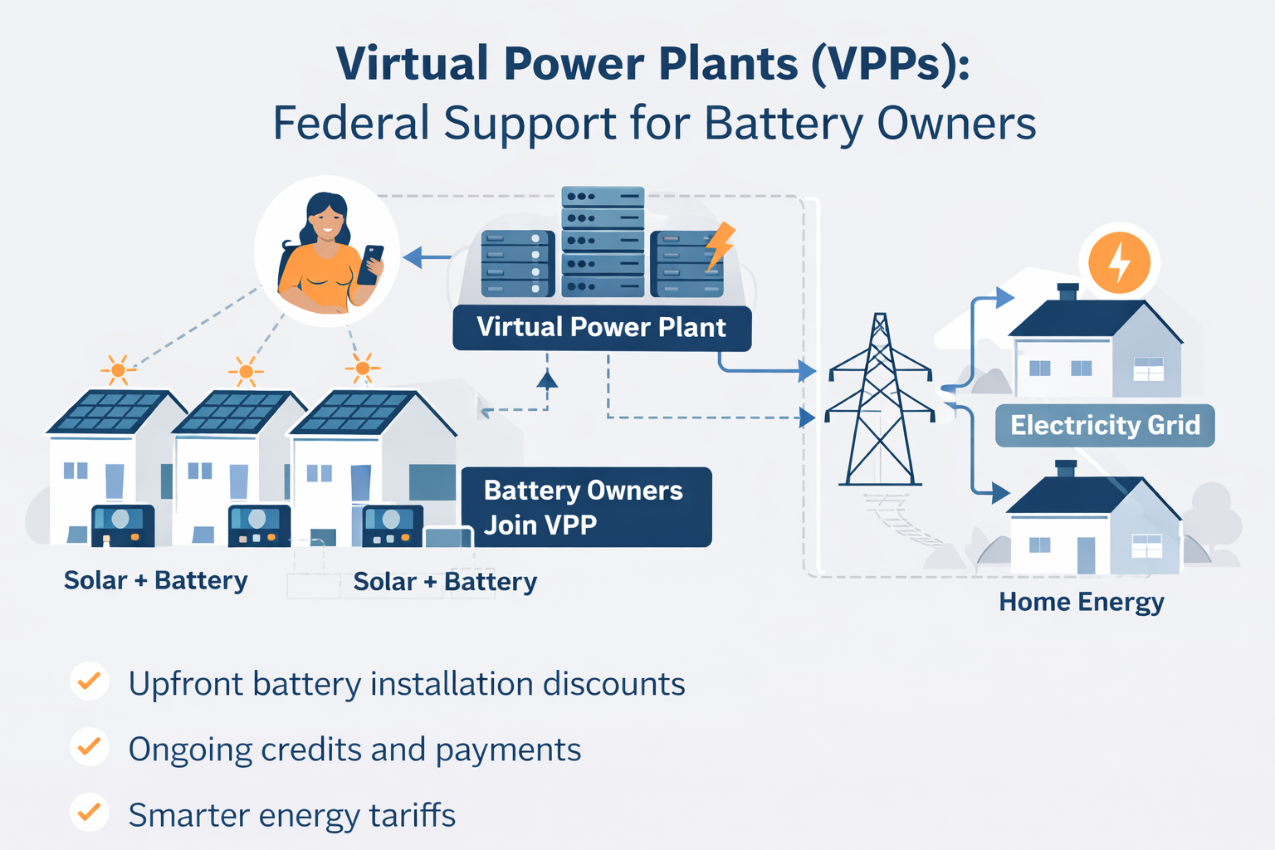
One of the biggest ways batteries are supported nationally is through Virtual Power Plant programs.
What is a VPP?
A VPP connects thousands of home batteries to work together as a shared energy network. During peak demand, stored energy can be dispatched to stabilise the grid.
Why this matters for homeowners
By joining a VPP, households may receive:
upfront discounts on battery installation
ongoing credits or payments
access to smarter energy tariffs
In 2026, VPP participation has expanded significantly, especially in Queensland and New South Wales, making batteries more financially viable.
State-Based Battery Incentives in 2026
Because battery rebates are largely handled at the state level, eligibility depends on where you live.
Queensland
Queensland continues to support battery uptake through:
retailer-led battery incentives
VPP programs
targeted energy affordability initiatives
QLD homeowners benefit from:
high solar generation
strong battery performance due to climate
frequent outages in some regions, increasing the value of backup power
New South Wales
NSW remains one of the most active states for battery incentives, with:
interest-free loan schemes
VPP participation incentives
energy efficiency upgrade programs
For NSW homeowners on time-of-use tariffs, batteries can significantly reduce peak energy costs.
Who Can Claim Battery-Related Incentives in 2026?
Eligibility depends on the specific program, but generally applies to homeowners who:
own their property
have an existing or new solar system
meet electricity usage thresholds
install approved battery brands
use accredited installers
Some programs also require:
internet connectivity
smart meters
participation in grid support programs
Because incentives vary, it’s important to assess eligibility case by case.
Are Battery Rebates Income-Tested?
Unlike some solar programs, most battery incentives are not strictly income-tested, though certain energy affordability schemes prioritise low-income households.
VPP programs and retailer incentives typically focus more on:
system size
battery capacity
grid location
This means many middle-income households still qualify for meaningful savings.
How Much Can Incentives Reduce Battery Costs?
In 2026, battery pricing has continued to improve, but incentives still make a noticeable difference.
Depending on the program, homeowners may receive:
$1,000 to $4,000 in effective savings
reduced upfront costs
ongoing bill credits over time
When combined with solar rebates and rising electricity prices, this can significantly shorten battery payback periods.

Is It Better to Install a Battery Now or Wait?
For most homeowners, waiting for a “perfect” rebate isn’t necessary.
Here’s why:
electricity prices continue to rise
feed-in tariffs remain low
batteries provide immediate bill reduction and blackout protection
incentives are often capped or limited in availability
In many cases, the savings you miss by waiting outweigh the benefit of a potential future rebate.
Common Misconceptions About Battery Rebates
❌ “There’s a big federal rebate coming soon”
There is no confirmed nationwide battery rebate announced for 2026. Current support remains indirect.
❌ “Batteries aren’t worth it without rebates”
Many homes still achieve strong returns without rebates, especially in QLD and NSW.
❌ “Only low-income households qualify”
Many battery incentives are open to standard owner-occupied homes.
How to Maximise Battery Savings in 2026
To get the best outcome:
size your solar system correctly
choose a battery suited to your usage
consider VPP participation
install a hybrid inverter
work with an installer who understands current incentives
A tailored approach always delivers better results than chasing rebates alone.
Final Thoughts: What 2026 Means for Australian Homeowners
While Australia still doesn’t offer a simple federal battery rebate like solar panels, 2026 has brought stronger overall support for battery storage through a mix of federal policy, state programs, and energy market incentives.
For homeowners in Queensland and New South Wales, batteries are becoming:
more affordable
more valuable
more future-proof
Understanding what’s available and acting at the right time can lead to significant long-term savings.

Thinking About a Battery for Your Home?
At Powered By Solar, we help homeowners across Queensland and New South Wales navigate battery options, rebates, and incentive programs with clarity and honesty.
We’ll assess:
your current solar system
your energy usage
available incentives
realistic payback timelines
So you can make a confident, informed decision.
👉 Get in touch with Powered By Solar to see what battery incentives you may qualify for in 2026.


