Solar Export Limits in QLD & NSW | Why You Can’t Export All Your Power
Solar Export Limits in QLD & NSW: Why You Can’t Send All Your Power to the Grid
Typical Export Limits in QLD & NSW
How Export Limits Affect Your Savings
Why Bigger Solar Systems Still Make Sense
What Can You Do About Export Limits?
1. Use More Solar in Your Home
3. Consider Smart Energy Devices
4. Look Into Flexible Export Options
5. Join a Virtual Power Plant (VPP)
QLD vs NSW: What’s the Difference?
If you’ve installed solar panels expecting to export excess energy and earn credits, you might be surprised to learn:
You can’t export all the solar power your system produces.
Across Queensland and New South Wales, many homeowners are subject to solar export limits and they can significantly affect how much value you get from your system.
So why do these limits exist, and what can you do about them?
Let’s break it down in simple terms.
What Are Solar Export Limits?
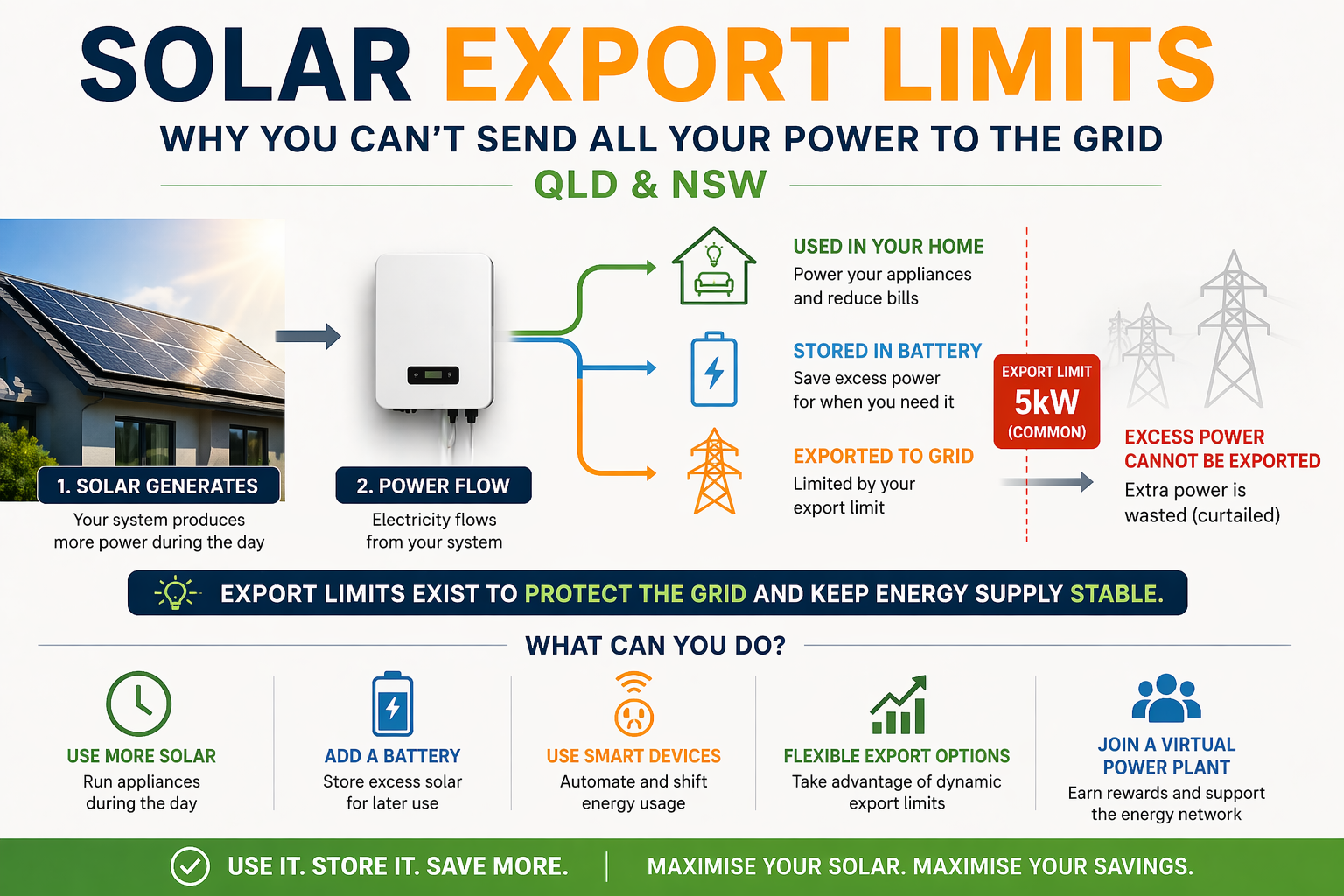
A solar export limit is the maximum amount of electricity your system is allowed to send back to the grid.
Even if your system produces more energy, anything above that limit:
Cannot be exported
Instead, it is either:
Used in your home
Or “curtailed” (wasted if unused)
Typical Export Limits in QLD & NSW
While it varies depending on your network provider, common limits include:
5kW export limit (very common for residential homes)
Lower limits in congested areas
Flexible or dynamic export limits in some regions
For example:
You might have a 10kW solar system, but still only be allowed to export 5kW at any time.
Why Do Export Limits Exist?
This is the big question homeowners ask:
“If I generate the power, why can’t I send it all to the grid?”
The answer: Grid capacity.
The electricity grid was not originally designed for:
Thousands of homes generating power
Large volumes of solar exports during the day
In many QLD and NSW suburbs:
There is already too much solar being exported at the same time
This can lead to:
Voltage issues
Grid instability
Equipment damage
Export limits help keep the system stable.
How Export Limits Affect Your Savings
This is where it really matters.
If your system is limited:
You earn less from feed-in tariffs
Excess solar may go unused
Your expected ROI may change
Example:
Your system generates 8kW
Your export limit is 5kW
You’re only able to export part of what you produce
The rest must be used or it’s lost
Why Bigger Solar Systems Still Make Sense
At first, this sounds like a reason to avoid larger systems.
But in reality:
Bigger systems can still be very beneficial
Why?
You can use more energy during the day
You can charge batteries or EVs
You reduce reliance on the grid
The key is:
Designing your system for self-consumption, not export
What Is Solar Curtailment?
When your system produces more energy than you can use or export, the inverter reduces output.
This is called:
Curtailment
It means your system is capable of producing more but is being restricted.
This is increasingly common in high solar areas of QLD and NSW.
What Can You Do About Export Limits?
The good news is you have options.
1. Use More Solar in Your Home
The simplest solution:
Increase self-consumption
Run appliances during the day:
Washing machines
Dishwashers
Pool pumps
Air conditioning
This reduces wasted energy and increases savings.
2. Add a Battery System
A battery allows you to:
Store excess solar
Use it at night
Avoid exporting at low rates
Instead of losing energy due to export limits:
You keep it and use it later
3. Consider Smart Energy Devices
Smart systems can:
Automatically shift energy usage
Prioritise solar consumption
Optimise energy flow
This includes:
Smart hot water systems
Load controllers
Smart EV chargers
4. Look Into Flexible Export Options
Some areas in QLD and NSW are introducing:
Dynamic or flexible export limits
This allows:
Higher export when grid demand is low
Reduced export during peak solar periods
It requires:
Compatible inverter
Network approval
But it can improve system performance over time.
5. Join a Virtual Power Plant (VPP)
If you have a battery, a VPP can:
Use your stored energy to support the grid
Provide financial incentives
Increase overall system value
This turns your home into part of a larger energy network.
QLD vs NSW: What’s the Difference?
Queensland
High solar adoption
Export limits common in suburban areas
Strong push toward flexible exports
New South Wales
Increasing grid congestion in urban areas
Growing use of dynamic export systems
Higher peak pricing increases value of self-use
Both states are evolving quickly as solar adoption grows.
Should Export Limits Stop You from Getting Solar?
Not at all.
Solar still provides strong value through:
Reduced electricity bills
Energy independence
Long-term savings
The strategy has simply changed.
It’s no longer about exporting as much as possible
It’s about using your solar as efficiently as possible
Solar export limits are becoming more common across QLD and NSW but they don’t reduce the value of solar.
They just change how you maximise it.
The smartest homeowners in 2026 are:
Using more of their own solar
Adding batteries where it makes sense
Adapting to smarter energy systems
If your system is hitting export limits, it may be time to optimise how your energy is used not just how much you generate.

Want to Get More Value from Your Solar System?
At Powered By Solar, we help homeowners across Queensland and New South Wales design smarter systems that work within export limits while maximising real savings.
Whether you’re looking to:
Upgrade your system
Add a battery
Or improve your energy usage
We can help you find the right solution.


