Should You Upgrade Your Solar System? When to Add Panels or Replace Your Inverter
Should You Upgrade Your Solar System? When to Add Panels or Replace Your Inverter
Signs Your Solar System May Need an Upgrade
When Should You Add More Solar Panels?
Can You Add Panels to an Existing System?
When Should You Replace Your Solar Inverter?
Should You Upgrade the Inverter When Adding Panels?
Many homeowners across Queensland and New South Wales installed solar systems between 2012 and 2018. At the time, a 3kW or 5kW system was common.
Fast forward to today. Electricity prices have increased. Households use more power. Electric vehicles and batteries are becoming more popular.
If your energy bills are rising despite having solar, it may be time to consider an upgrade.
This guide explains when adding panels makes sense, when an inverter replacement is required, and what homeowners in Brisbane, Gold Coast, Sydney and Newcastle should consider.
Signs Your Solar System May Need an Upgrade
Not every system needs upgrading. However, these are common indicators:
• Your electricity bills are increasing
• You have added an EV or plan to
• Your family size has grown
• Your inverter is over 8 to 10 years old
• Your system capacity is under 6.6kW
• Monitoring shows lower than expected output
In many QLD and NSW homes, older systems were designed for lower electricity usage than today.
When Should You Add More Solar Panels?
Adding panels is often suitable if your system:
• Has available roof space
• Has an inverter that supports expansion
• Was originally installed at a smaller size
• Does not meet current household demand
Many Brisbane and Sydney homes installed 5kW systems years ago. With higher energy usage and lower feed in tariffs today, increasing system size can improve self consumption.
However, there are technical limitations.
Can You Add Panels to an Existing System?
It depends on:
Inverter Capacity
Your inverter must be able to handle additional panel input.
If it is already operating at maximum capacity, you may need a new inverter or a second system.
Network Export Limits
Distribution networks in QLD and NSW have export limits. Adding panels may not increase export capacity unless re approved.
Roof Orientation
North facing roofs generally produce the most energy. East and west facing panels can help extend production into the morning or afternoon.
A professional assessment is required before expanding any system.

When Should You Replace Your Solar Inverter?
Solar inverters typically last 8 to 15 years depending on brand, environment and installation quality.
Common signs of inverter failure include:
• Error messages
• System shutting down frequently
• Reduced output
• No monitoring data
• Visible fault lights
In coastal areas like the Gold Coast or Newcastle, salt air and humidity can shorten inverter lifespan.
Replacing an old inverter may improve system efficiency and allow future battery compatibility.
Should You Upgrade the Inverter When Adding Panels?
In many cases, yes.
If your inverter is:
• More than 8 to 10 years old
• Not battery compatible
• Undersized for your new system
• No longer supported by the manufacturer
Upgrading to a modern hybrid inverter may provide long term flexibility.
Hybrid inverters allow future battery integration without major system redesign.
Is It Worth Upgrading a 6.6kW System?
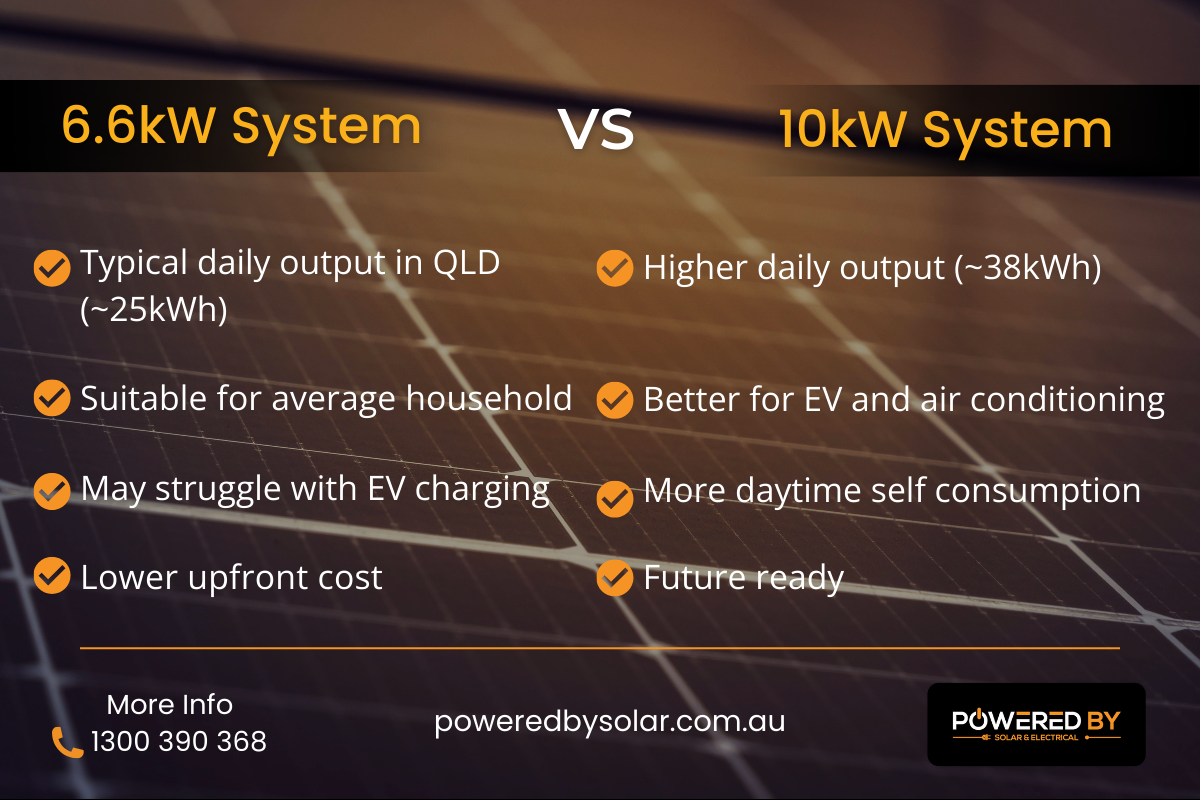
6.6kW became the standard size for many QLD and NSW homes.
However, for households with:
• EV charging
• Air conditioning use
• Pool pumps
• High daytime occupancy
A 10kW or larger system may better suit modern energy needs.
Estimated savings vary depending on system size, household energy use, roof orientation, electricity rates and feed in tariffs. Figures are general examples only and not guaranteed outcomes.
Costs to Consider
Upgrading a solar system may involve:
• Additional panels
• New inverter
• Electrical compliance updates
• Switchboard modifications
• Network approval
Costs vary depending on equipment quality and installation complexity.
Before upgrading, homeowners should assess long term electricity consumption trends rather than short term bill spikes.
QLD vs NSW Considerations
Queensland
Solar adoption is high. Many homes in Brisbane and the Gold Coast have systems installed during earlier rebate periods. Export limits may apply when increasing system size.
New South Wales
Time of Use tariffs are common. Larger systems paired with batteries can reduce exposure to peak pricing.
Understanding local network rules is essential before upgrading.
Should You Upgrade or Add a Battery Instead?
If your current system produces enough energy but you use most electricity at night, adding a battery may be more effective than adding panels.
If your system struggles to cover daytime usage, increasing panel capacity may be the better first step.
Every home is different, and system design should reflect usage patterns.
Upgrading your solar system may be worthwhile if:
• Your energy usage has increased
• Your inverter is ageing
• You plan to add an EV
• Your current system is under 6.6kW
• Monitoring shows performance issues
Homeowners in Queensland and New South Wales should assess both technical compatibility and network regulations before proceeding.
A properly designed upgrade can improve self consumption, reduce grid reliance and future proof your home.

At Powered By Solar, we make it easy to choose the system that suits your lifestyle and budget. Whether you’re going on-grid, hybrid, or fully off-grid, our team designs and installs high-quality systems using trusted brands like Sungrow, Tesla Powerwall, and Sigenery.
From custom design to government rebates and ongoing support, we’ll help you make the switch to clean, reliable solar power the smart way.
Ready to take control of your energy? Contact Powered By Solar today for a free consultation and personalised quote.


